


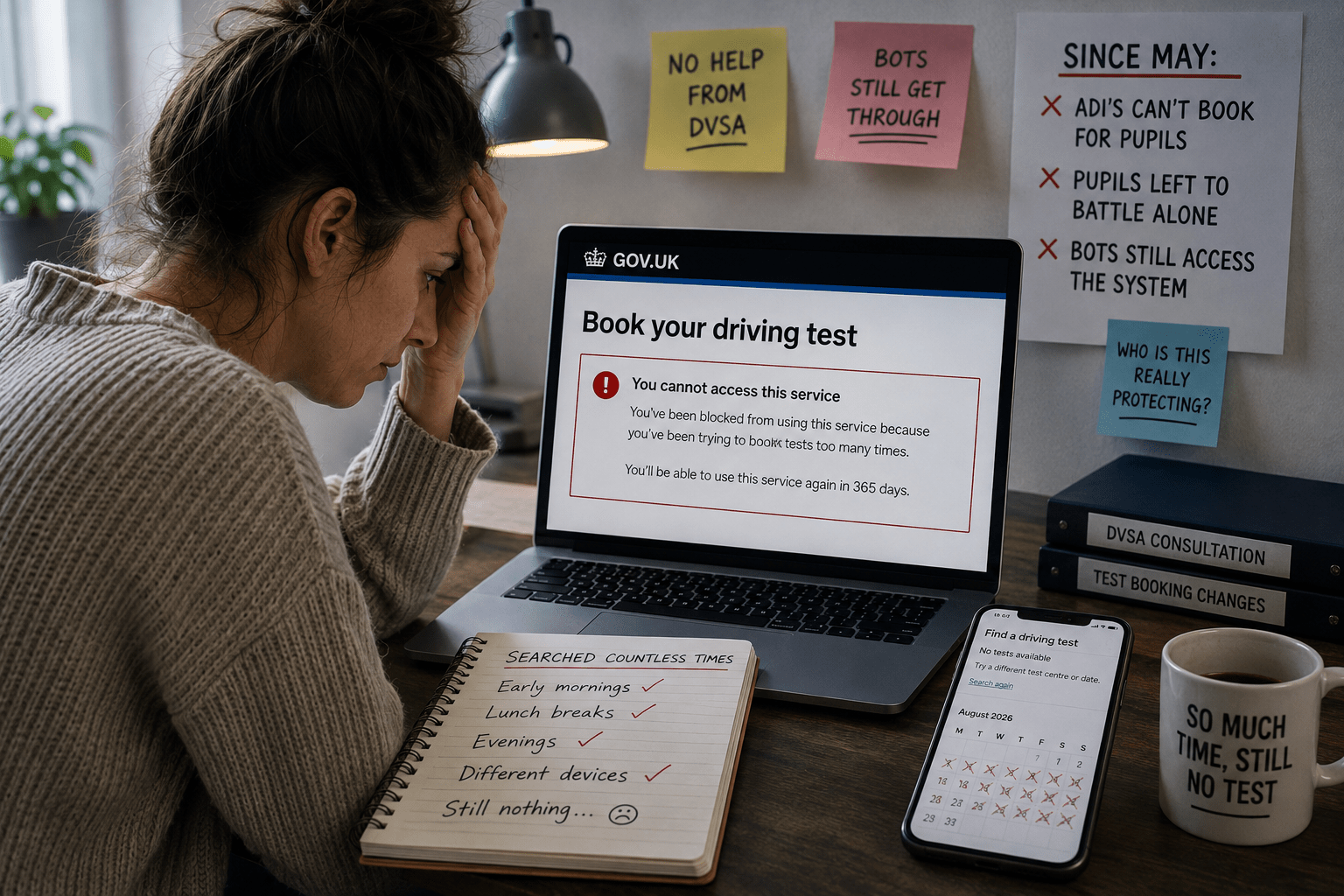
The booking system has undoubtedly been exploited by bots, unofficial cancellation services and brokers reselling appointments at inflated prices. A National Audit Office investigation found that almost a third of respondents to a DVSA survey had used a third-party reseller, with some paying as much as £500 for a test carrying an official weekday fee of £62. However, the crackdown resulted in a regulated user being kicked out of the system, pupils floundering without ADI ability to support their booking effectively and the bots still accessing the system.
Since May only learner drivers have been permitted to book or manage their own car tests. Driving instructors can no longer do so on a pupil’s behalf.
The DIA has questioned not only the effect of this change, but the process through which it was introduced. Although a consultation took place, the association argues that it did not make sufficiently clear that the resulting rules would legally prevent instructors from booking tests for their pupils. It believes a change of this significance should have involved fuller consultation with trainers, learners and other affected stakeholders.
Removing instructors from the process has left learners to navigate a highly competitive booking system alone. For some, that means repeatedly checking for appointments, refreshing pages and acting as quickly as possible when a suitable test appears. These are understandable responses to scarcity, but they can also resemble the automated behaviour the system is designed to detect.
That creates an uncomfortable possibility: measures intended to stop commercial exploitation may be restricting the very learners they were supposed to protect. Instructors are no longer permitted to manage the process for them, while pupils attempting to manage it themselves risk being locked out if their activity is judged not to resemble “normal personal use”.
Carly Brookfield, chief executive of the DIA, has asked DVSA for urgent advice for pupils and trainers. The association wants clearer guidance on the type of activity that may result in a block, what learners should do when it happens and whether contact-centre staff are equipped to help those who believe they have been caught incorrectly.
And the reality is, after all of these changes – bots are still accessing the system (detecting them and having to throw them out of the booking platform means they are still able to get in, even if you are able to stop them doing much – ‘wins’ in increasing detection rates don’t mean you’ve eradicated all bot access to the system.
And don’t start us on the DVSA telephone test swap fiasco that gave birth to a whole new market of third party apps offering to help pupils find and perform a driving test swap…
And in determining who really should access a test booking system, let’s consider what perhaps should have been properly considered before the crackdown on access. Pupils aren’t knowledgeable, regulated professionals in using this system and in judging when they are test ready. And the bots are certainly not governable (in the way the regulator likes you to think they can achieve), nor do they care whether a pupil is ready for licensure – they just want to sell a commodity.
ADIs are regulated, governable and have the professional knowledge to judge when it’s time to book a test for a candidate. They also have professional risk in using the platform properly, and in presenting pupils for a test before they’re ready for licensure, so the majority won’t risk their professional status by doing bad things in the system or booking tests for pupils too soon (DVSA have still to produce any solid evidence of ADIs being significant bad actors in the system, a claim which underpinned their original decision-making).
Making pupils book tests via a regulated professional would limit access – and that’s a good thing as it would both help control quality and quantity of candidates coming through the system, supporting better test resource management and helping better assure new licensee competency and safety. The question DIA has always asked, in this context, why did we disable what should be the professional gatekeeper role in booking driving test, verses enabling them to be the control?
Read the full DIA Special Report
Download The Real Driving Test Hustle?
Read the full series:
Questions over net new examiner numbers
New examiners waiting to be deployed while pupils wait for tests
Locked out and left waiting: pupils blocked by DVSA’s bot protection
A crackdown with unintended consequences?
Selective social media, missing updates and an invisible new CEO
DIA membership is here to support and represent you
DIA represents and supports driver and rider trainers, challenges the issues affecting the profession and makes sure your voice is heard.
Membership also gives you expert support, £25m PI & PL insurance, training and CPD, member benefits and more.

One Response
With all that has passed, I can not with all good conscience accept that the affect the DVSA have caused was not their main intention, and/or was not known to them prior to this happening.
The DVSA have shown themselves to be untrustworthy. I have been hearing from examiners the phrase ‘de-escalation’ being driven down their throats from above. It seems that tests are being marked weaker to create a higher pass rate in an effort to help reduce the backlog. The DVSA should no longer be allowed to utter the words – ‘road safety’. They have become an abomination. They are dishonest, unreliable and deceitful in their actions. Where is Warmington? Well as far as I can tell it’s a small town/village just off the M40 near Banbury in Oxfordshire. Perhaps it is just another name for Loveday Ryder. Rumour has it they have never been seen together at the same time.
The DVSA have not supplied their evidence that 3000 ADI’s were selling tests for profit. They have also not provided any explanation as to why they will not provide any information to support not providing this detail.
Deceitful, Vulgar, Sly, Antagonists